


Fall Outage: Planning, Speed, and Safety
In the power generation industry, timing is everything. While spring turnarounds allow facilities to recover from cold-weather stress and prepare for summer peak demand, the fall outage season presents a different scenario and a unique timeline.
Achieving success during a fall outage requires more than traditional maintenance scheduling; it demands a highly disciplined workforce strategy. When hundreds of specialized craft workers descend upon a single site for an intensive, three-week period, project success hinges on four critical pillars:
- Meticulous Pre-Outage Preparation: Planning workflows, alignment, and logistics well before work begins.
- Rapid Contractor Mobilization: Efficiently onboarding and deploying skilled labor without losing momentum.
- Unyielding Safety Standards: Maintaining uncompromising site protocols under tight schedule pressure.
- Strategic Post-Outage Talent Retention: Preserving top-tier talent and operational insights for future projects.
In this blog post, we break down strategies used to master the fall outage cycle.
Key Takeaways:
- Fall outages differ from spring outages; intense summer operation introduces unique mechanical wear, thermal stress, and unpredictable scope changes.
- Scope freezing should occur 90 to 120 days prior to the breaker trip, backed by mid-July diagnostics to lock in maintenance needs.
- Due to intense regional competition for specialized crafts, utilities should establish a detailed Skill Matrix 120 days in advance to map required certifications and grades.
- Streamlined site logistics for workers are recommended, including digital onboarding, staggered arrival schedules, and structured 15-minute supervisory shift hand-offs.
- Maintaining a “Zero-Harm Under Pressure” culture requires non-negotiable Stop Work Authority (SWA), live Job Safety Analyses (JSAs), and dedicated EHS leadership.
- Conducting a post outage audit within two weeks evaluates schedule variance, TRIR, and rework rates to establish a baseline for future outage planning.
- Partnering with specialized staffing agencies to track high-performing craft workers creates a retention pipeline, securing top-tier talent for future cycles.
I. The Crunch Time: Preparing for the High-Intensity Window
After months of continuous, high-load operation during mid-summer, power generation assets across North America are pushed to their limits. The fall outage window is the time to address this wear and tear, and its timeline is uniquely compressed. Plant operators face a narrow, rigid schedule sandwiched between the tail end of summer grid demands and the impending winter heating loads. A typical fall outage window often spans just 14 to 28 days.
Many power utilities and independent power producers (IPPs) treat the fall maintenance window as a scaled-down replica of the spring outage. Let’s explore why this is a mistake, and how the fall outage is unique.
Summer Asset Stress and Scope Volatility
Unlike spring maintenance focused on planned aging and winter damage, fall outage scopes are uniquely defined by the deferred risks and mechanical strain of extreme summer operation.
- Summer Capacity Strain: Prolonged operation at peak capacity during extreme heat induces mechanical wear across assets.
- Deferred Repair Backlog: Critical repairs are often delayed during high-revenue summer months, creating a backlog for the fall schedule.
- Key Asset Vulnerabilities: Fall scopes frequently target key asset issues like steam turbine vibration anomalies, heat recovery steam generator (HRSG) tube leaks, and feed pump seal degradation.
To prepare effectively, outage managers must execute project scope freezing no later than 90 to 120 days prior to the breaker trip.
Early diagnostic engineering (infrared thermography, oil analysis, and baseline vibration checks) conducted in mid-July allows utilities to lock in critical scope items long before mobilization of supplies and staff.
Mapping Critical Path Skills in a Tight Labor Market
- The North American power sector continues to confront a profound skilled labor shortage. High-demand crafts required for a successful fall outage are heavily scouted. Because hundreds of power plants enter their outage windows simultaneously, competing for top-tier talent requires early workforce alignment.
Strategic Action Item: The 120-Day Skill Matrix
- Outage directors can partner with specialized staffing providers like APS Solutions at least four months in advance. Establishing a granular Skill Matrix—mapping every critical path task down to the exact certification, craft grade, and badging level—prevents last-minute staffing shortfalls when regional labor markets freeze in September.
Supply Chain & Lead-Time Mapping
Strategic preparation also involves mapping supply chain lead times for specialized components, valves, and heavy-lift rigging gear. A delayed rotor arrival or late valve casting can completely derail a tight 21-day timeline.
By aligning procurement, plant operations, and labor staffing into a synchronized master schedule, utilities create a resilient buffer against unexpected schedule slips.
What are the high demand staffing positions for the fall outage?
Mechanical & Heavy Craft:
- Millwright / Turbine Specialist
- Specialty Combo Welder (TIG/SMAW)
- Pipefitter / Steamfitter
- Boilermaker
- Certified Rigger / Heavy Crane Operator
Electrical, I&C & Inspections:
- Industrial Electrician
- I&C Technician
- Protective Relay Technician
- NDT / NDE Inspector (UT/RT/MT/PT)
Specialized Service Techs:
- Safety Valve Technician
- Field Machinist
- QC Inspector (Mechanical/Electrical)
Access & Support Labor:
- Scaffold Builder / Carpenter
- Industrial Insulator / Lagger
- EHS / Safety Technician
II. Mobilization: Coordinating Contractors in a 3-Week Window
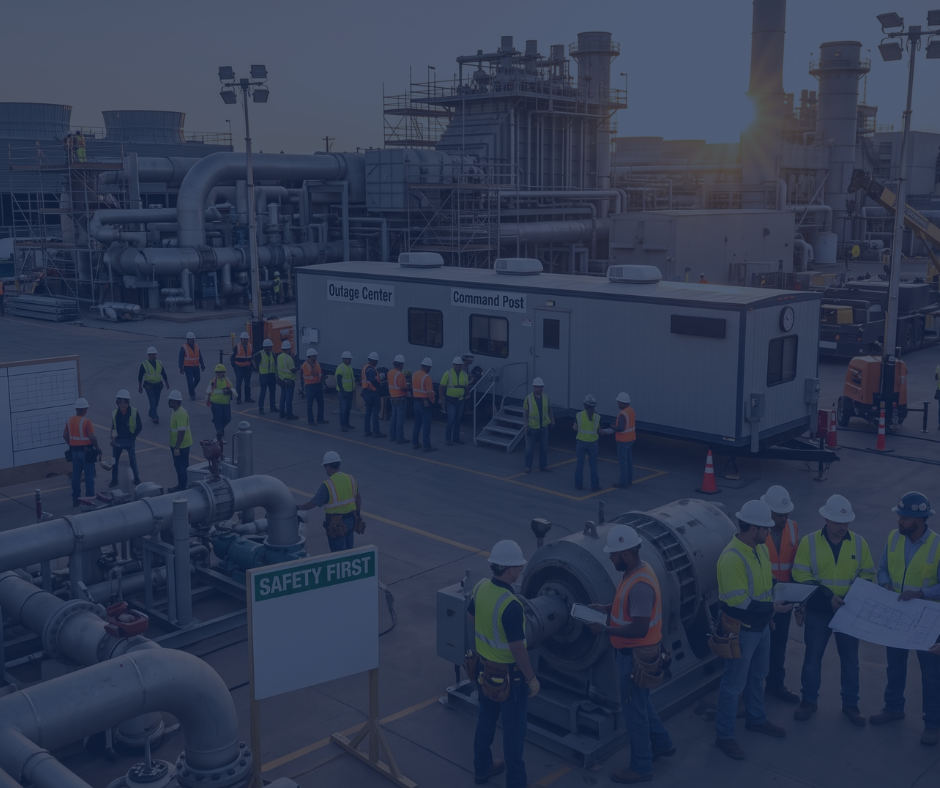
When the turbine trips and turning gear engages, the clock begins ticking. Mobilizing hundreds of contractors onto a single power plant site within a 48-to-72-hour window is one of the most complex logistical feats in industrial management. A poorly executed mobilization creates immediate bottlenecks, badging backlogs, safety vulnerabilities, and lost labor hours.
Streamlining Onboarding, Badging, and Screening
Conducting badging, site orientation, drug screening, and background checks on Day One of an outage leads to schedule delays and costs that can be avoided. Additionally, processing hundreds of contractors through a single site security entry on Monday morning brings its own set of challenges.
To help eliminate this friction, leading power companies leverage pre-mobilization clearance frameworks:
- Off-Site Digital Badging & Orientation: Completing mandatory OSHA general safety overviews, environmental health and safety (EHS) site rules, and hazard communication training online prior to arrival.
- Pre-Cleared Fit-for-Duty Screening: Conducting standardized background checks, DISA drug testing, and respiratory fit testing at regional centers up to two weeks before site deployment.
- Staggered Arrival Schedules: Structuring craft arrival times based on critical-path priorities (e.g., scaffolding and insulation crews arrive at Hour 0, boilermakers at Hour 12, precision millwrights at Hour 24).
Shift Scheduling and Multi-Craft Hand-Off Protocols
Executing a 24/7 fall outage requires rotating 12-hour shifts. The hand-off between shifts represents the highest risk point for miscommunication, re-work, and safety oversights. Implementing structured, 15-minute supervisory shift-overlap meetings ensures that critical path status, LOTO boundaries, and pending permit-to-work statuses are seamlessly transferred.
Furthermore, coordinating project timing for craft workers like scaffold builders, insulation technicians, and valve mechanics requires centralized field communication. Establishing dedicated area coordinators prevents different contractors from tripping over each other or waiting idly for access tags.
III. Safety Under Pressure: Maintaining Standards When the Clock is Ticking
In the high-stress environment of a compressed fall outage, schedule pressure is probably the greatest threat to safety. When the clock is ticking and production deadlines loom, workers are naturally tempted to take shortcuts. In the power generation sector, where personnel work alongside high-pressure steam, electrical systems, overhead cranes, and confined spaces, a single lapse can have catastrophic consequences.
Cultivating a “Zero-Harm Under Pressure” Culture
Maintaining safety standards during a fall outage requires establishing an uncompromised safety culture from the start. Safety cannot be viewed as a secondary compliance check; it must be embedded as a primary guideline. A safe job is an efficient job.
Key components of an effective outage safety program include:
- Uncompromising Stop Work Authority (SWA): Every contractor, regardless of employer or rank, must have authority to stop any task if an unsafe condition is observed, without fear of schedule backlash.
- Dynamic Job Safety Analysis (JSA): JSAs must be live documents updated at the worksite whenever scope, environmental conditions, or nearby craft activity changes.
- Dedicated Safety Leadership: Place qualified EHS specialists and safety observers on the floor to provide real-time coaching, spot hazards, and ensure active oversight.
Managing Fatigue in 7×12 Outage Schedules
Fatigue is a silent hazard that compounds rapidly during a multi-week fall outage. Operating on a 7-day, 12-hour shift schedule leads to diminished cognitive function, delayed reaction times, and heightened risk tolerance by Day 10 to 14. Outage leaders must enforce strict fatigue management policies, including mandatory rest days after 14 consecutive shifts, active shift rotation tracking, and hydration/thermal stress monitoring during late summer/early autumn heat waves.
By prioritizing worker health, clear risk mitigation, and active supervisory presence on the floor, plant leadership ensures that every craft worker returns home safely at the end of the outage.
IV. Lessons Learned: Post-Outage Analysis and Talent Retention for Next Season
The conclusion of a fall outage—when the generator synchronizes back to the grid and the main breaker closes—is not the end of the outage lifecycle. In fact, the immediate post-outage period is considered the best opportunity to capture operational intelligence and secure competitive advantages for future outage seasons.
Conducting the Comprehensive Post-Outage Audit
Within two weeks of outage completion, plant leadership, key contractors, and staffing partners should convene for a comprehensive Post-Outage Debrief.
This audit evaluates performance against established Key Performance Indicators including:
- Schedule Variance: Actual vs. planned duration across all critical-path work packages.
- EHS Metrics: Total Recordable Incident Rate (TRIR), first-aid cases, and near-miss reporting counts.
- Quality & Re-work: Weld reject percentages, valve repacking success rates, and post-startup warranty claims.
Documenting unexpected scope creep, hidden asset degradation discovered during inspection, and contractor performance creates an invaluable repository of “tribal knowledge.” This data forms the baseline for planning the next spring and fall outage cycles, preventing repeated mistakes and optimizing budget allocations.
Building a Sustainable Talent Pipeline & Preferred Roster
In a tight power sector labor market, losing high-performing personnel after the fall outage ends represents a massive loss of human capital. Re-hiring and re-training entirely new crews every season adds friction, lowers quality, and increases safety risks.
To break this costly cycle, top-performing power producers partner with APS Solutions to build a year-round talent retention pipeline by:
-
Evaluating Craft Performance: Assessing individual worker performance during fall outages to pinpoint top-tier talent.
-
Building Preferred Contractor Rosters: Placing proven performers on dedicated rosters for priority placement on future scopes.
-
Sustaining Year-Round Engagement: Keeping highly skilled professionals active across regional spring outages, summer maintenance windows, and capital projects.
By providing craft workers with long-term career continuity, utilities guarantee a reliable, high-performing workforce season after season.
V. Fall Outage Strategy: Partnering for Outage Excellence
Executing a successful fall outage is a masterclass in operational discipline, workforce management, and safety commitment. By transforming the fall turnaround from a high-stress scramble into a structured, predictable process, power generation teams can maximize availability, maintain compliance, and safeguard plant longevity.
At APS Solutions, we specialize in delivering high-caliber, pre-screened technical and craft talent tailored specifically to the rigorous demands of the power and energy industry. Whether you are preparing for a 14-day combined-cycle turnaround or a major multi-unit nuclear overhaul, APS Solutions provides the staffing strategies, mobilization support, and workforce leadership required to complete your fall outage on time, on budget, and with zero incidents.
Looking to optimize your upcoming outage strategy? Connect with the power workforce specialists at APS Solutions today.